Club History
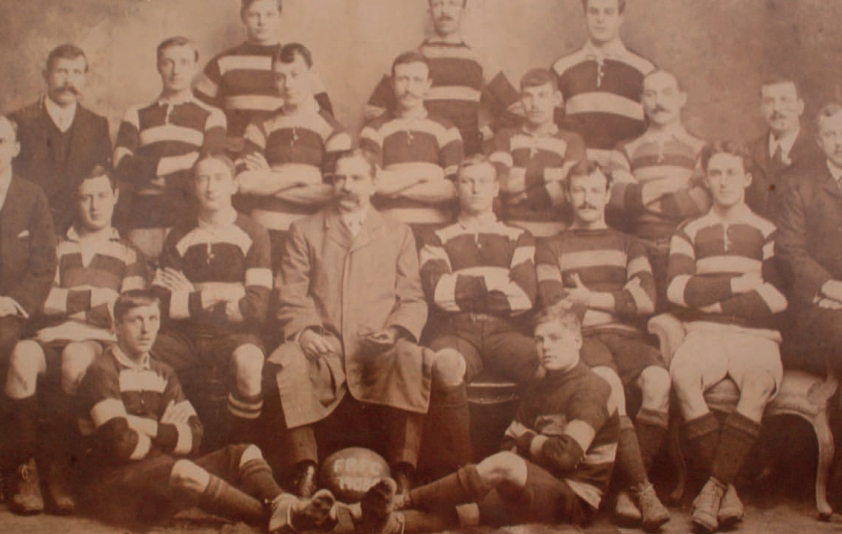
Frome Rugby Football Club has proudly represented the town since 1883. While various local sides played regularly prior to that era, they represented individual organisations rather than the town itself.
Victorian Origins & Early Days (1883–1914)
In 1886, the club officially affiliated with the Frome Athletic Club. Though early records are scarce, it appears the club’s first Captain was likely H. B. Sheppard.
Before the First World War, the club’s primary headquarters was based at the Angel Hotel, with matches played down at Wallbridge. At the Annual General Meeting on Thursday 16th December 1886, members resolved to establish a second team and invited Lord Weymouth to become the club’s President—an invitation that was gladly accepted.
Life as a member of Frome Rugby Club in the 1880s came with a healthy appetite for a post-match meal, as "any excuse for a dinner was good enough." On the pitch, opposition varied widely, featuring local outfits such as Shepton Mallet and the Selwood Printing Works.
From the Archives: The 1887 Hedge Incident Ahead of the match against Selwood Printing Works on 19th February 1887, organisers issued a stern warning to spectators: "Attention is drawn to the fact that a hole was made in the hedge surrounding the Pitch and anyone doing the same or similar deed will be prosecuted."
The pitch itself was kindly loaned by Mrs Sinkins, and large crowds routinely paid gate money to watch. Financial records from the Athletic Club's 1888–1889 meeting noted that the total cost of running the Rugby Club for an entire season was just £5.8s.7d.
The Inter-War Years & The Shadow of War (1914–1945)
Nine days after the outbreak of the First World War, the Rugby Union called upon its players to join the forces—a call answered wholeheartedly by the men of Frome RFC. The devastation of the war hit the club hard, and it was not until 1926 that rugby finally returned to Frome.
On 28th April 1926, interested locals gathered at the Lamb Hotel on Bath Street to formally re-establish the club. Interest was so overwhelming that a second team was swiftly formed.
-
The Ground: The new home pitch was set up at the top of Nunney Road.
-
Matchday Logistics: Match fees were 1 shilling, and transport to fixtures relied on whatever was available—ranging from bicycles to charabancs.
-
Social Scene: The social highlight of the year was the Annual Rugby Dance—a lavish affair that reportedly upstaged even the Annual Dinner in local prestige.
At an AGM at the Lamb Hotel, the Chairman presented Mr L. B. Browne with a wristwatch in recognition of his tireless efforts to revive the club. Shortly afterwards, headquarters shifted to the George Hotel, remaining the main venue until the Second World War. On-field fortunes between the wars, however, saw a sharp decline, with both the 1st XV and the A XV losing roughly 50% of their matches between 1926 and 1937.
Post-War Wandering & The Lean Years (1945–1969)
The period immediately following the Second World War brought fresh challenges. With many young local men still serving in the forces, recruitment relied heavily on nearby military establishments rather than local schools, where rugby was rarely played.
Finding suitable after-match venues proved difficult, and the club eventually lost the Nunney Road ground it had held since 1926. A nomadic era followed as the club shifted playing fields across Frome:
-
The Showground
-
Berkeley Road
-
Bath Road playing fields
-
Gypsy Lane
-
Occasional stints at Oldford, Clink Road, and Critchill.
Headquarters on the Move: The post-war era saw the club bounce between local hostelry. The primary venue was the Sun Inn, before moving back to the Lamb Hotel in 1953, followed by stints at the Mansford Wine Vaults, The Crown, and occasionally the Vine Tree.
By the early 1960s, results had plateaued, and the club reached a low point. More successful regional rivals viewed Frome as a somewhat ramshackle affair capable of "coarse rugby" rather than the finer elements of the game.
The 1960s Press-Gangs True to the ebb and flow of club rugby fortunes, legends from the mid-sixties recall that if fielding a full first team proved tricky on a Saturday morning, a certain senior committee member responsible for fixtures would wait until just before lunchtime, sweep into local hostelries, and press-gang reluctant recruits into playing!
The Modern Era & Community Roots (1970s–Present)
Thanks to the persistence of dedicated officers, the late sixties saw Frome successfully field a Second Fifteen once again. By the early 1970s, the 1st XV was holding its own against all-comers, expanding the club to four—and occasionally five—sides.
A major turning point for player development was the introduction of rugby at Frome Grammar School (now incorporated into Frome College), providing a steady stream of young local talent.
A Permanent Home (1975): After decades of moving around, a joint venture with the Cricket Club and the Frome and District Agricultural Society culminated in the building of a brand-new clubhouse, officially opened in 1975.
Today, Frome RFC is a thriving community hub built on strong foundations:
-
The Youth Section: Our flourishing Mini & Junior sections run right from U6s through to U16s, feeding directly into the Colts/Academy XV.
-
Senior Rugby: The 1st XV competes proudly in the Southern Counties South League (Level 7), backed by a competitive 2nd XV, 3rd XV, and the Frome Cavalry XV veterans side, who still love to dust off their boots for local and touring fixtures.
From a £5 operational budget and Victorian hedge-jumpers to a modern multi-team community club, the spirit of Frome Rugby Football Club remains as strong as ever.